
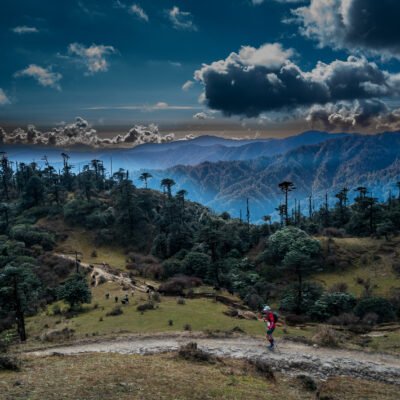
In the early 1900s, the Aga Khan, ruler of much of India, instructed his men to build a trail in the North-East Himalayan ranges. He had heard great tales of a spot high in the mountains, bordering present-day Nepal, where it was possible to see four Giants at once, and he wished to travel there. The trail was built, and though the Great Khan never made it to that spot, much of that trail still exists, as do the giant mountains that he wished to see.
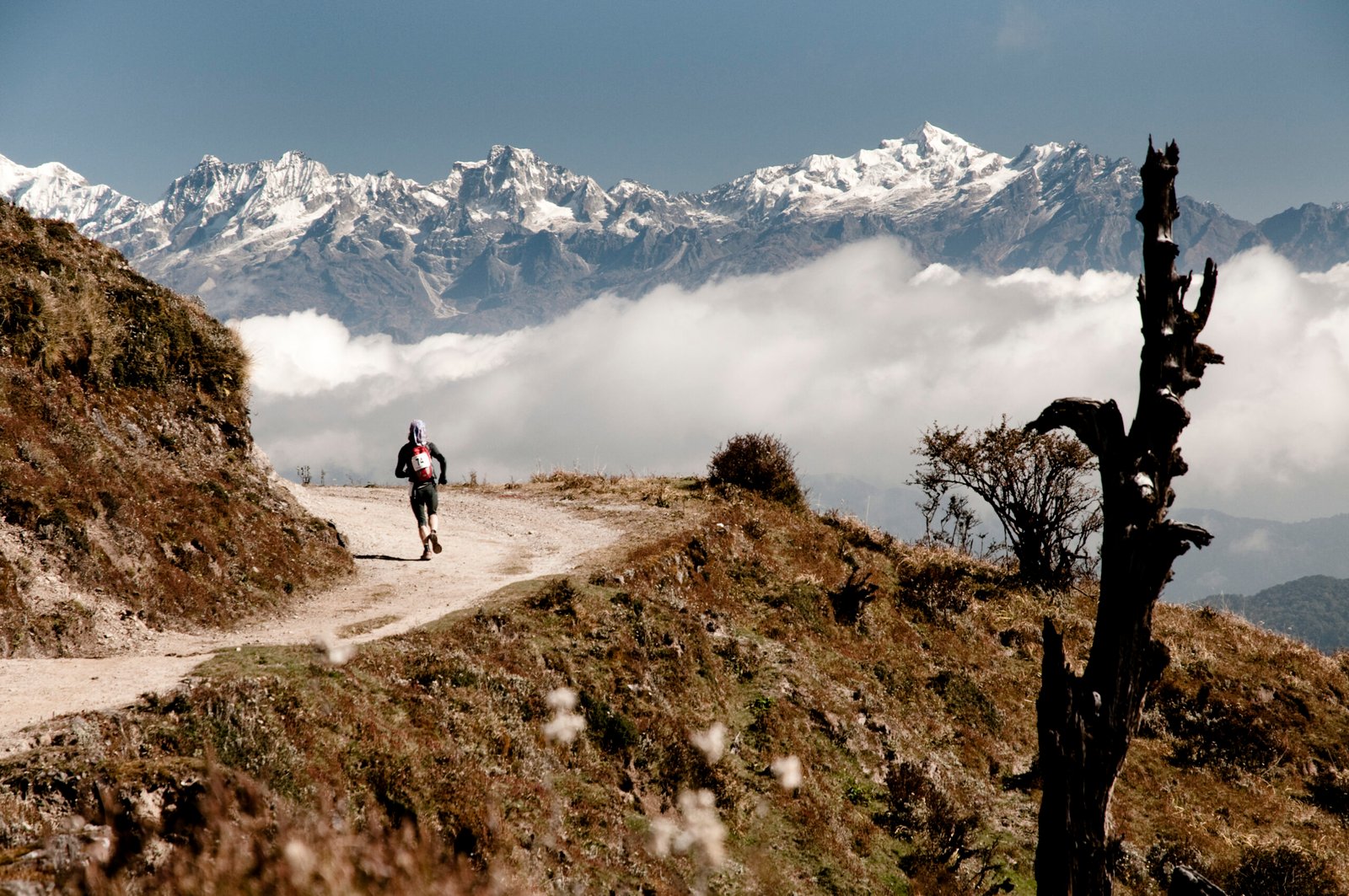
The Himalayan 100-Mile Stage Race was first organized in 1991 to retrace the trail of the Aga Khan. Beginning with a team of just thirteen adventurers, it expanded in 1994 to include the Mt. Everest Challenge Marathon. Taking place entirely in Indian territory along the border with Nepal, the Himalayan 100 Mile Stage Race & Mt. Everest Challenge Marathon (HSR/ECM) is now one of the world’s premier mountain racing events, featuring five race stages of 24, 20, 26, 13 and 17 miles. The altitude along the course varies from 6000 to 12000 feet above sea-level, and offers participants amazing views of four out of five of the highest mountains in the world: Mt. Everest, Kanchenjunga, Lhotse and Makalu.
Over the years, it has built a reputation for providing a world-class event that combines a spectacular race-course with excellent ground support services.
There are no specific rules, age limits, or stage cut-off times. Anyone physically fit & interested can run and walk.
Himalayan 100 Mile Stage Race is now an International Trail Running Association (ITRA) National League Event, further strengthening its position within the international trail running community.
To be officially ranked, athletes must finish a minimum of three ITRA-member league races within a single country during the calendar year.
• Himalayan 100 Mile Stage Race – 4 ITRA Points
• Himalayan 100K Stage Race – 3 ITRA Points
• Mt. Everest Challenge Marathon – 2 ITRA Points
It is World’s first and only AAA rating Eco-friendly race and culturally-sensitive event, consistent with its guiding philosophy on presenting a positive message on life and nature to its participants, with positive cultural interaction.
What Makes the Himalayan 100 Mile Stage Race Unique?
The mountain trail is primitive and characteristic, as it offers an opportunity to experience the culture, heritage of thousands of years, religion, peculiar customs and traditions, besides the thrilling adventure enjoyment.
The magnificent landscape tempts runners to slow down to look at the stunning views of snow-capped peaks, sprawling valleys dotted with centuries-old monasteries, scenic villages, pristine forests, unpolluted crystal-clear skies, and natural water channels. There is so much to see, feel, and experience during this race that it should come as no surprise that so many participants describe it as their “once-in-a-lifetime adventure.
Participation
Himalayan Run & Trek’s Himalayan 100 Mile Stage Race and Mt. Everest Marathon Challenge has been described as the most spectacular running course in the world. Regardless of your level of ability – whether a 10K, marathoner, or ultramarathon runner – you can run at your own pace. There are no age limits – the youngest participant was 12 years old, and the oldest was 76 – or stage cutoff times. The aim of this event is not winning, but to enjoy nature.
Goal
The goal of the Himalayan 100 Mile Stage Race and Mt. Everest Challenge Marathon is to continue to offer runners from around the globe an exceptional experience that transcends socio-economic and cultural barriers, uniting them in a unique adventure that aims to provide excitement, community, committed conservation, and above all, strives to expand global peace and tranquility.
Schedule
Your 8-day trip starts with arrival at Bagdogra airport and transfer to Mirik, located near Darjeeling. Includes shared accommodation at Mirik Lake Resort, mountain huts at Sandakphu, lodges at Rimbik, all meals, transportation, aid stations, guides, porters, full race support, and Bagdogra Airport transfers.
Early Arrival Option at Mirik Lake Resort is available at an extra cost. Includes accommodation, meals, lodging, guided sightseeing, airport transfer. Early arrival allows extra time to acclimatize, recover from jet lag, visiting tea estates, monasteries and shopping markets.
Conservation and preservation
Since the inception of Himalayan Run Trek, one mission has always been kept in mind that activities taken place under the supervision of this organization should be environmental friendly and the echo of Eco should reach every corner of this world. This motive has always been a driving force for HRT and its team to continue its efforts towards conservation and preservation of Himalayan environment for present and future generation by encouraging afforestation, renovation of many ponds in the Himalayan villages at the higher altitude, disposing off the garbage with sound environmental practices, re-establishment of natural habitats of flora and fauna, minimizing the cultural impacts, developing and imparting the concept of maintaining an eco-balance of body and mind, encouraging trekkers and hikers to pick the garbage from the routes left by the other general tourists and disposed off in a proper and environment friendly manner etc.
The organization is also involved in educating the locals about the conservation and preservation of the natural resources in and around them along with the solid waste management.